The Salesforce DevOps landscape
Gearset has earned its reputation as the leading Salesforce DevOps tool. Strong git integration, reliable deployments, good comparison tools, and a team that understands the pain of Salesforce metadata management. If you're a development-heavy Salesforce team, Gearset is probably on your shortlist.
Pocavi approaches the same problem from a different angle. Instead of building the best standalone DevOps tool, we built DevOps as one module inside a broader Salesforce operations platform. The deployment features overlap significantly with Gearset. The difference is what comes alongside them.
Deployment and release management comparison
Both platforms handle the core deployment workflow: detect changes between two orgs, review what's different, validate with a dry run, and deploy. Both support rollback. Both have approval workflows for production deployments.
Gearset's strength is git integration. It connects directly to GitHub, GitLab, Bitbucket, and Azure DevOps. You can deploy from a git branch, compare branches to orgs, and run CI pipelines triggered by pull requests. For teams that have adopted source-driven development with scratch orgs and a proper git workflow, Gearset's git support is excellent.
Pocavi supports git integration too (GitHub, GitLab, and Bitbucket via OAuth), but it's not the primary workflow. Pocavi's sweet spot is org-to-org comparison and deployment. Detect what changed in your sandbox, review it visually, validate it, and push it to production. No git knowledge required. This is how most admin-heavy teams actually work.
Pocavi also includes a visual pipeline builder where you chain orgs together with approval gates and quality checks between them. Dev to UAT to Staging to Production, with each step requiring sign-off. Gearset has pipeline support as well, though their implementation leans more heavily on git branches as the pipeline mechanism.
Analytics and metrics
Gearset tracks deployment history and gives you visibility into what was deployed, when, and by whom. It's practical and covers the audit requirements most teams have.
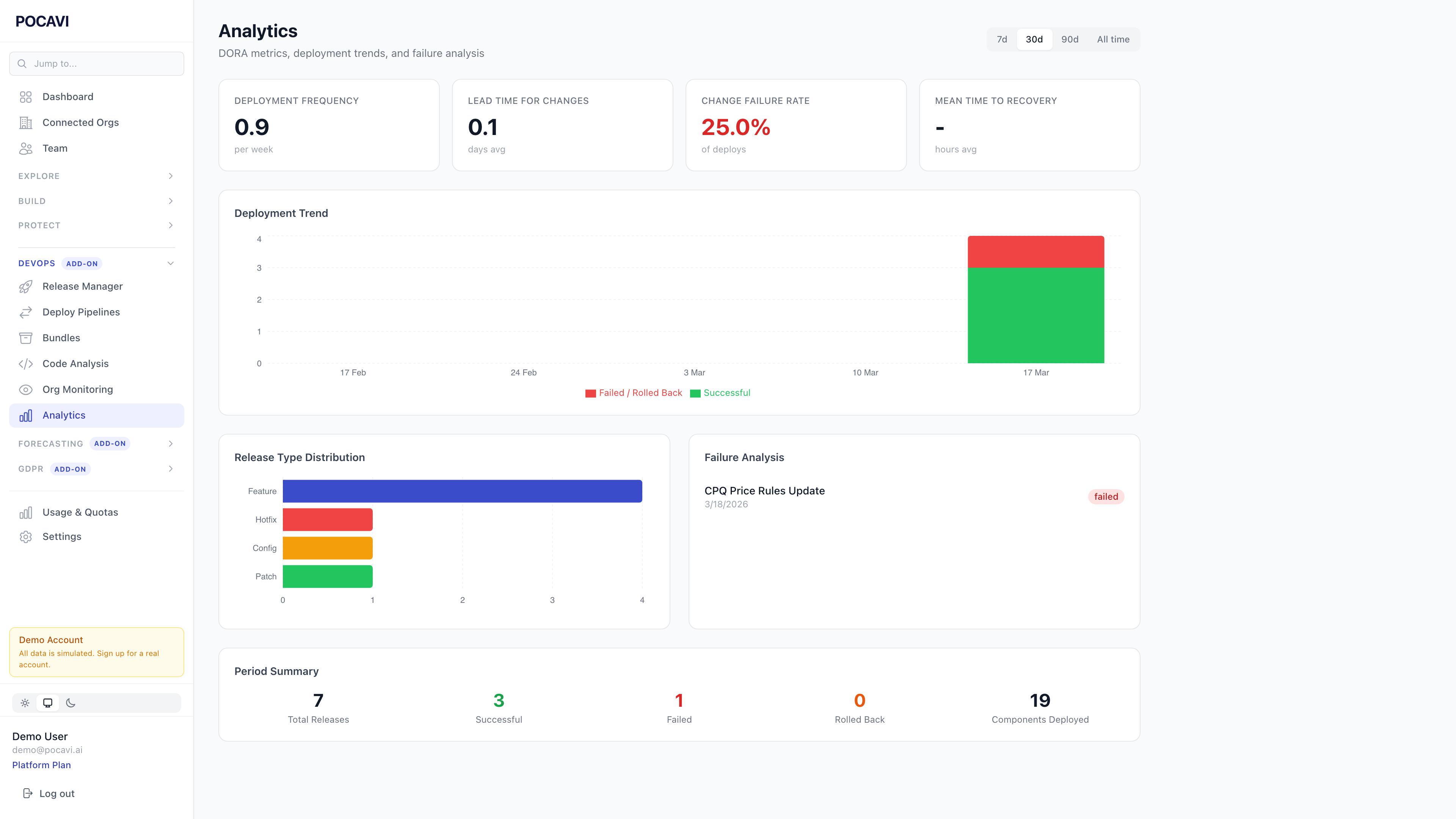
Pocavi goes further with full DORA metrics: deployment frequency, lead time for changes, change failure rate, and mean time to recovery. You get trend charts, period comparisons, and team-level breakdowns. For teams that report on engineering performance or want to track improvement over time, the analytics are more comprehensive.
Pocavi also includes AI-generated release notes. After a deployment, the AI reads the metadata changes and writes human-readable release notes describing what changed and why it matters. Four preset templates (technical, stakeholder, executive summary, changelog) plus custom templates. It's a small feature, but it saves the 30 minutes someone spends writing release notes after every deployment.
Pricing: per-seat vs platform
Gearset uses per-seat pricing. Depending on the tier, expect roughly $60 to $100 per user per month. For a team of 5 developers and admins, that's $3,600 to $6,000 per year. For 15 users across dev, admin, and release management roles, $10,800 to $18,000 per year.
Pocavi's DevOps features are available two ways. Smart Deploy (org-to-org comparison and deployment) comes with Pocavi Admin at $799/month per Salesforce estate. The full DevOps platform (release management, pipelines, DORA metrics, integrations, code analysis, scheduled deploys) is the DevOps product at $149 per delivery user per month, with a three-user minimum.
Admin and Compliance are priced per Salesforce estate, not per user, so a 5-person team and a 25-person team pay the same for them. That $799/month for Admin also includes metadata backup, org health scanning, field impact analysis, permissions matrix, data loader, SOQL query tool, and monitoring. Gearset's per-seat fee covers deployments only.
When each makes sense
Choose Gearset if you're a development-heavy team with a mature git workflow. If your team uses scratch orgs, feature branches, and pull request-based CI/CD, Gearset's deep git integration is hard to beat. If deployments are your primary pain point and you already have other tools covering backup, monitoring, and compliance, Gearset is a focused, well-built solution for that problem.
Choose Pocavi if your team is a mix of admins and developers, or if you want to consolidate multiple tools into one platform. If you're currently paying for Gearset plus OwnBackup plus a monitoring tool plus a GDPR tool, Pocavi replaces most of that stack. The DevOps features are strong enough for most teams, and the flat-rate pricing means you don't worry about licence counts as the team grows.
For teams where deployments are one of several problems (not the only problem), the platform approach tends to win on value. You get DevOps that's 80 to 90 percent of what Gearset offers, plus six other modules that Gearset doesn't touch, at a lower combined cost.
Try Pocavi's deployment and DevOps features in the interactive demo at pocavi.ai/demo. Org-to-org comparison, visual pipelines, DORA metrics, and release management. No signup required.