The revenue intelligence tax
Clari is a good product. It pioneered the revenue intelligence category, and for large enterprises with dedicated RevOps teams and big budgets, it delivers. But there's a pattern I keep seeing with mid-market Salesforce teams: they evaluate Clari, get excited about the pipeline views and deal scoring, then see the pricing.
Clari charges per seat. Depending on the tier and add-ons, that works out to roughly $50 to $100 per user per month. For a 20-person sales team, you're looking at $12,000 to $24,000 a year. For 50 users, $30,000 to $60,000. And that's just forecasting. You still need separate tools for Salesforce backup, deployments, GDPR compliance, and org health monitoring.
The total cost of the Salesforce ops stack adds up fast. Clari for forecasting. OwnBackup for backup. Gearset for DevOps. A GDPR tool. A monitoring tool. Five vendors, five contracts, five renewal conversations every year. Each tool does one thing well, but nobody connects them.
Per-seat vs flat-rate: the maths at scale
Pocavi Forecast is banded by the number of revenue users: $749/month up to 10, $1,499 up to 25, $2,499 up to 50. But here's the difference: that's on top of a platform that already includes metadata backup, smart deployments, org health scanning, data loading, permissions analysis, and field impact tools.
A Salesforce team taking Pocavi Admin ($799/month) and Forecast ($749/month) pays $1,548/month, or $1,161 with the 25% bundle discount. That replaces Clari, OwnBackup, and most of what Gearset does. Compare that to $2,000/month for Clari alone plus $800/month for OwnBackup plus $1,200/month for Gearset. The consolidation savings are significant.
Flat-rate pricing also removes the awkward conversation about who gets a licence. With per-seat tools, teams ration access. The VP of Sales gets a seat. The CRO gets a seat. But the sales managers who actually run forecast calls? Maybe they get read-only access. Maybe they use screenshots. With flat-rate pricing, everyone who needs the tool uses the tool.
Feature comparison: what both platforms do well
Let's be honest about where the two platforms overlap. Both Clari and Pocavi offer:
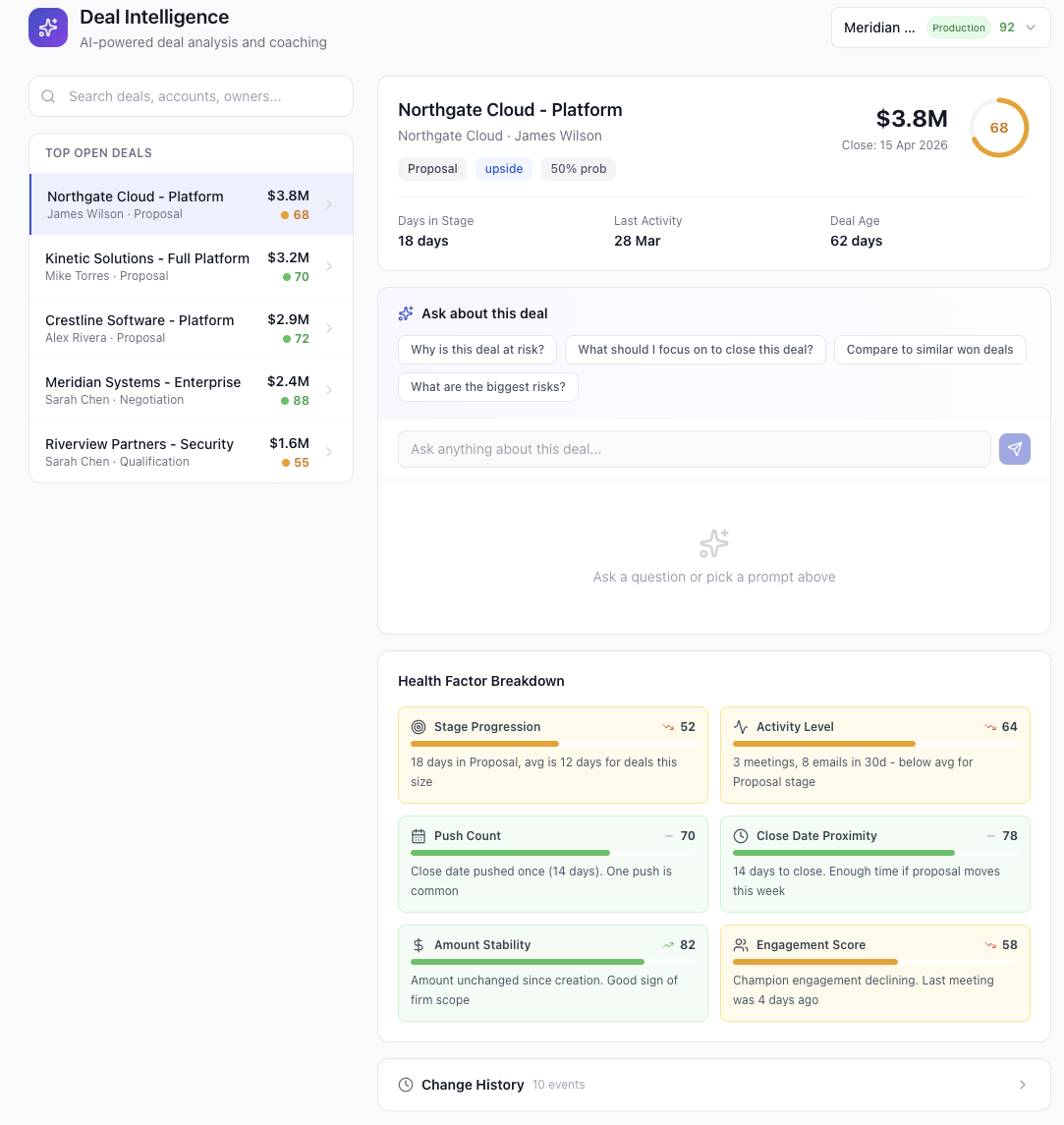
- AI deal scoring that analyses pipeline health beyond stage names
- Pipeline views with filtering by owner, stage, category, and close date
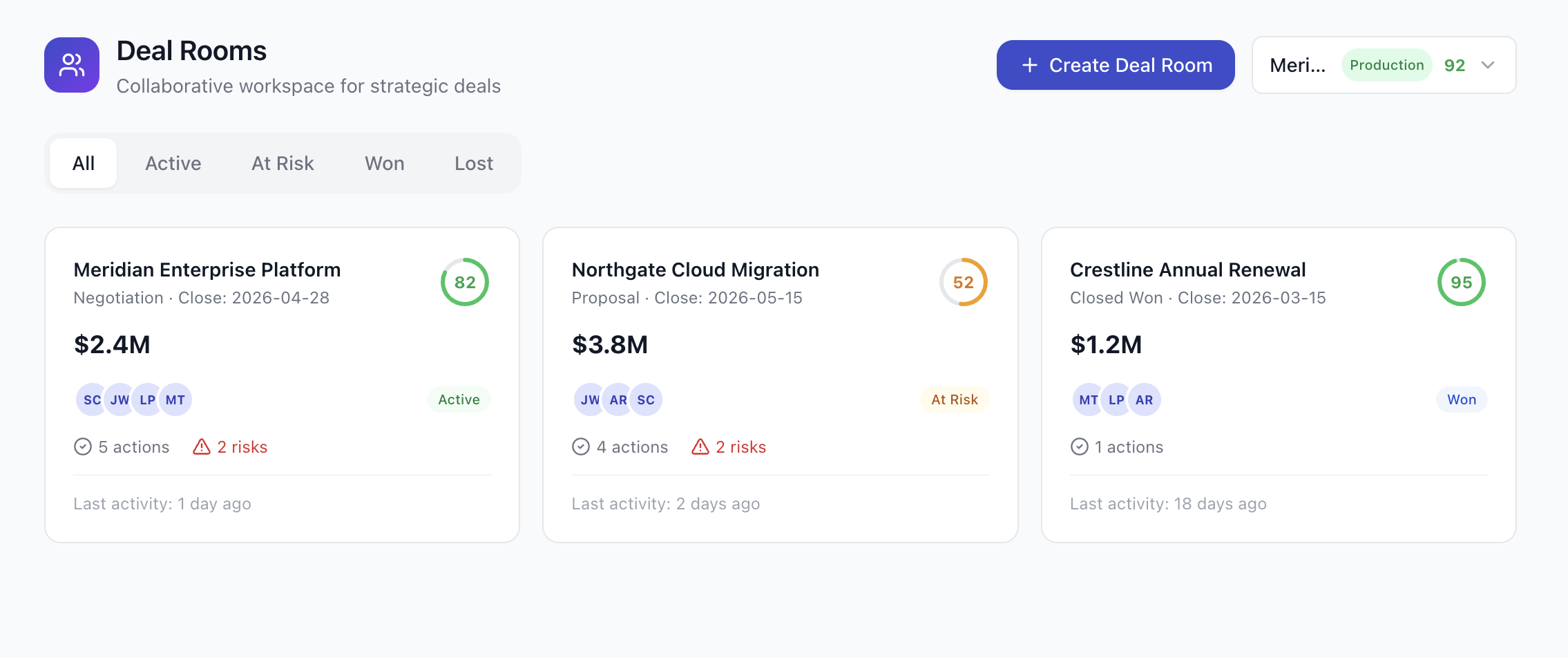
- Waterfall reports showing how pipeline changed over a period
- Role-based views so CROs, VPs, managers, and reps each see what matters to them
- MEDDIC qualification tracking per deal
- Forecast submission and rollup workflows
Clari has been doing this longer and has deeper integrations with email and calendar activity data. Their activity intelligence layer captures meeting and email engagement automatically, which gives their deal scoring more signals to work with. That's a genuine advantage for teams that rely heavily on activity data for pipeline inspection.
Pocavi's forecasting pulls signals from Salesforce data: stage progression speed, close date push count, amount stability, stakeholder coverage, and activity recency. It doesn't read your email. For most teams, the Salesforce signals are enough to identify deals that are stalling or at risk. But if email sentiment analysis is critical to your process, Clari has the edge there.
What Pocavi adds that Clari doesn't
This is where the comparison stops being like-for-like. Clari is a revenue intelligence tool. Pocavi is a Salesforce operations platform that includes revenue intelligence. The difference matters when you look at what else your team needs.
- Automated metadata backup with visual diff and one-click rollback
- Smart deployments between Salesforce orgs without git or change sets
- Full DevOps platform with release management, pipelines, and DORA metrics
- GDPR subject access requests and data anonymisation
- 19-category org health scanning with severity scoring
- Calculated fields engine for building UFR, NRR, and weighted pipeline without Apex
- AI-powered field impact analysis, permissions matrix, and data dictionary
- Live Salesforce Trust Status monitoring with incident alerts
None of these features exist in Clari because Clari isn't trying to solve those problems. But your Salesforce team still needs to solve them. The question is whether you want to buy five separate tools or one platform that covers the lot.
When each makes sense
Choose Clari if you're a large enterprise with a dedicated RevOps team, a substantial budget, and you need best-in-class revenue intelligence as a standalone product. If email and calendar activity intelligence is central to your forecasting process, Clari's deeper activity layer is worth the premium. If you already have your Salesforce ops stack sorted with other vendors and just need forecasting, Clari is a strong choice.
Choose Pocavi if you want to consolidate your Salesforce tool stack. If you're paying for 3 to 5 separate vendor tools and wondering why your Salesforce ops budget keeps growing, Pocavi replaces most of them with one platform. The forecasting module holds its own against dedicated tools, and the flat-rate pricing means you don't ration licences as you grow.
For mid-market teams especially, the consolidation argument is compelling. You get forecasting that's 80% of what Clari offers plus six other modules that Clari doesn't touch, at a fraction of the combined cost.
Try Pocavi's forecasting module in the interactive demo at pocavi.ai/demo. Deal scoring, pipeline views, waterfall reports, and role-based dashboards. No signup required.