For sales leadership and managers

Make the forecast call change what happens next.

POCAVI turns forecast movement into a practical leadership and manager workflow: see what moved, inspect the deals behind it, decide the next action, and learn from the outcome.

Book a Forecast workflow review

The Monday forecast call

Move from the total to the decisions that can still change the period.

Forecasting becomes useful when every leadership conversation creates a clearer action, rather than another request for an update.

Before the call

See the movement.

Compare the current forecast with the last submission and identify the teams, reps, stages, and deals responsible for the change.

In the call

Challenge the assumption.

Inspect coverage, velocity, qualification, activity, deal health, and the context behind the number before accepting the explanation.

In the 1:1

Coach the next action.

Give managers a focused view of stalled opportunities, deal risk, and the action that needs ownership after the conversation.

After the period

Learn the pattern.

Compare calls with outcomes to understand where assumptions held, where they did not, and how the next operating rhythm should improve.

Evaluate the outcome

Ask whether the forecast helps the team make better decisions.

During evaluation, use your current forecast cadence to test whether POCAVI makes movement easier to explain, manager time more specific, and the next action more accountable.

Explore Forecast
For the sales VPSee the revenue risk and leadership decisions behind the company number.
For RevOpsRun a reliable forecast cadence without rebuilding the context in spreadsheets.
For managersTurn the 1:1 into a deal decision rather than a status update.

Sales leaders and forecast owners

The forecast call reviews the number instead of changing it

An hour spent reading a total aloud is an hour not spent on the deals that would move it. The call needs the movement, the risk, and a next action per deal.

  • The call opens with a number nobody can decompose.
  • Risk is raised by whoever remembers it, not by the data.
  • Coaching happens on anecdote rather than on the last three deals.
  • Quota gaps are found at the end of the quarter.
22Forecast capabilities
ReconcilesMovement to a single figure
Per-dealRisk signals with reasons
WeeklySubmission cadence

What changes

Open the call with what actually moved

Opening pipeline, new, pulled in, pushed out, won and lost. The quarter reconciles to a single figure, and every bar drills into the deals behind it.

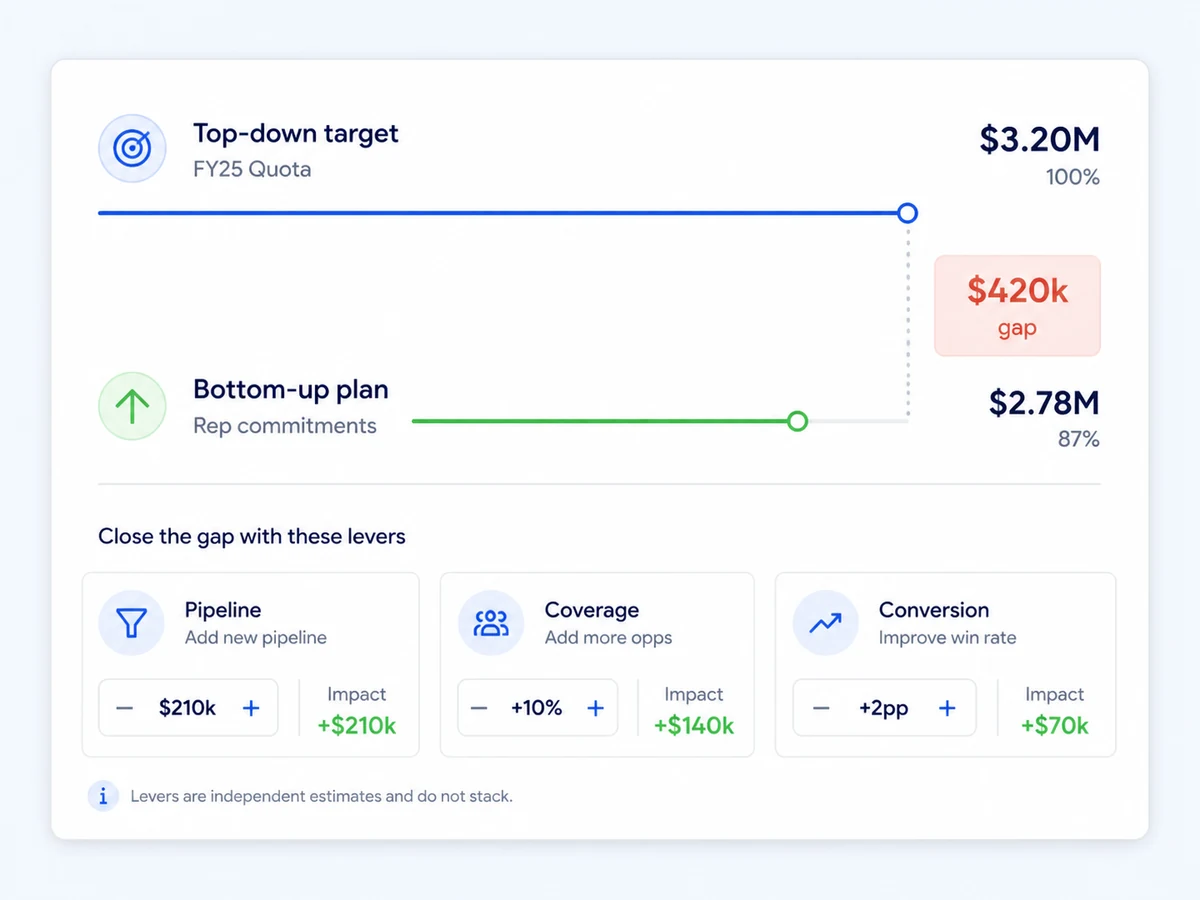
A top-down target against a bottom-up plan with a $420k gap and three levers

What changes

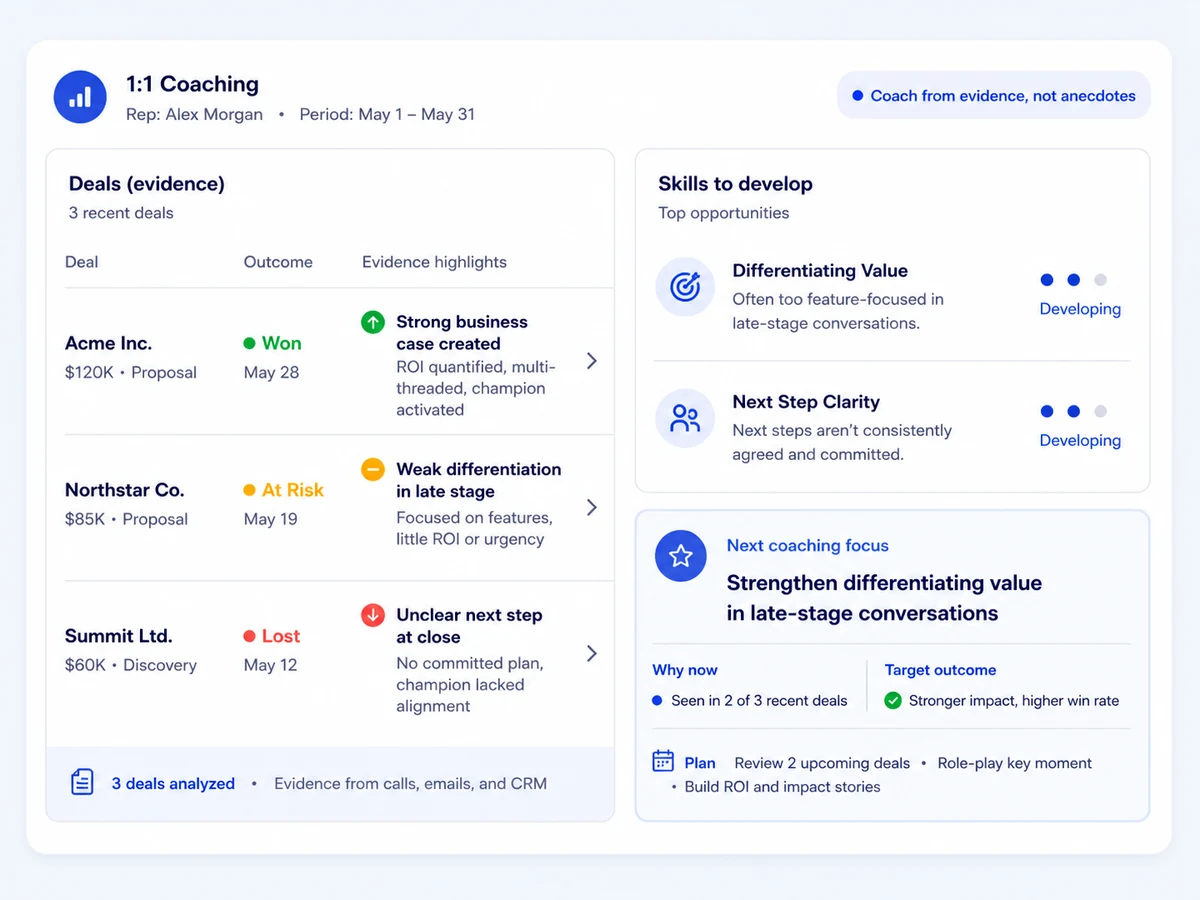
Coach from evidence, not anecdotes

Three recent deals, what happened in each, and the pattern across them. The one-to-one starts from what the deals show rather than what is recalled.

A coaching workspace showing three recent deals with evidence and a recommended focus

Capabilities

Everything Forecast brings to this work

Forecast is designed for the conversation behind the revenue number, not a separate dashboard that needs reconciling before every call.

  • AI Pipeline ForecastingBrings configurable lenses, role-based views, submissions, snapshots, risk signals, and forecast reporting into Salesforce context.
  • Pipeline OverviewProvides configurable forecast measures, role views, funnel, accuracy, history, and coaching insights.
  • Deal Risk and ScoringScores deals and surfaces win probability, risk factors, stale work, pushed deals, and closing signals.
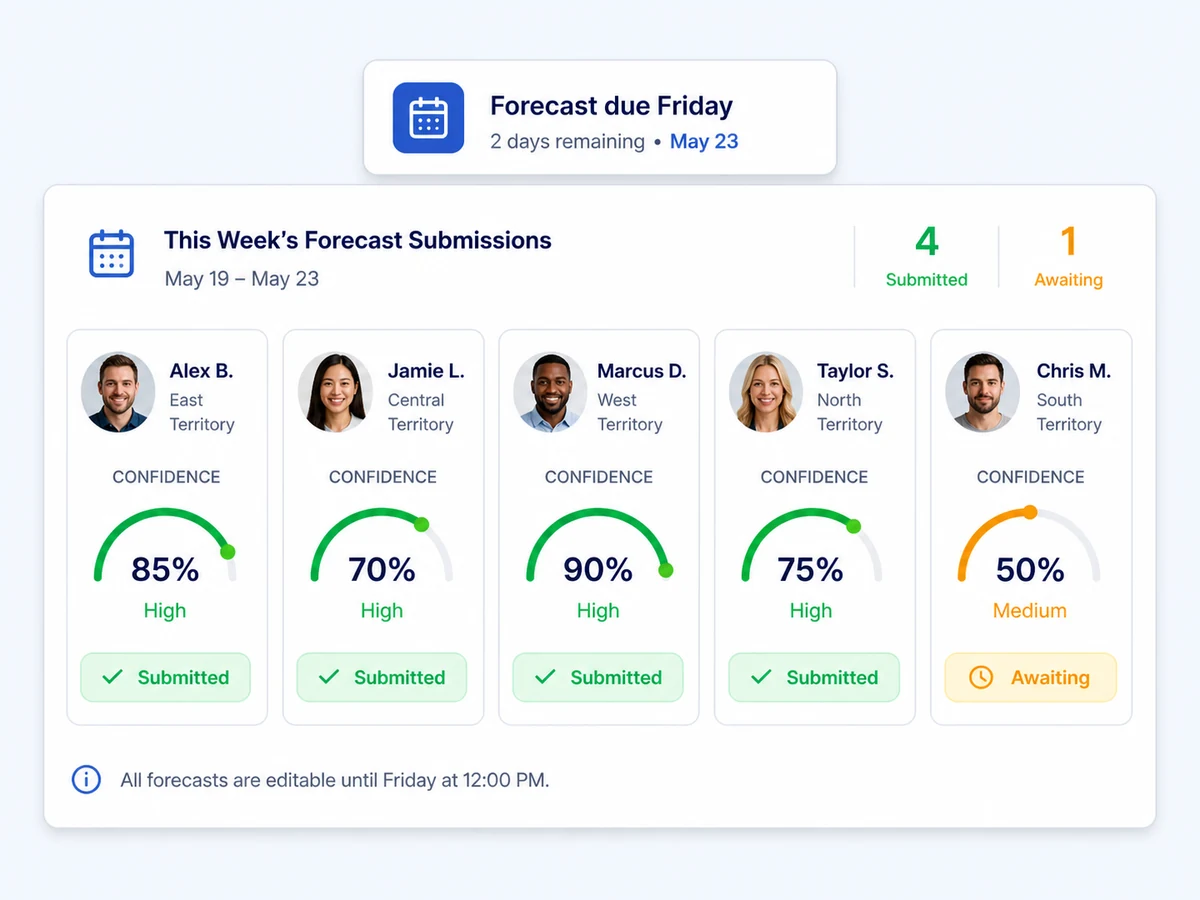
  • Forecast Submissions and HierarchyCollects commit, upside, and best-case calls with deadlines, team roll-up, history, and drill-down.
Five reps submitting weekly forecasts with confidence levels, one still awaited

Deal Rooms Creates a shared workspace for strategic opportunities with activity, stakeholders, risks, documents, action items, and meeting preparation.

Qualification and MEDDIC Makes qualification explicit through structured deal context and a consistent assessment process.

Coaching Scorecards Gives managers skill ratings, trends, team heat maps, goals, and coaching context across the revenue team.

Activity Intel, Call Prep, and Deal AI Uses activity and deal context to surface risk, prepare conversations, and point teams toward the next useful action.

Activity Intelligence Highlights deals with no activity, declining engagement, or strong engagement, including rep heatmaps.

Call Prep and Conversations Prepares a briefing with deal changes and coaching context, and connects call signals from conversation tools.

Mutual Action Plans Tracks buyer-facing actions, tasks, stalls, and a shareable plan for an opportunity.

Revenue Alerts Delivers severity-based alerts and custom rules for pipeline movement and submission reminders.

Conversation Intelligence Brings recent calls, deal signals, talk ratio, and deal-field enrichment into the revenue workspace.

Deal Velocity and Forecast Movement Shows how opportunities progress, where they stall, and which team, rep, or deal changed the forecast.

Revenue Analytics Provides waterfall, funnel, trend, accuracy, leaderboard, coverage, attainment, and dashboard views.

Reports and Dashboard Builder Creates waterfall, funnel, trend, leaderboard, accuracy, snapshot, and custom reports with shareable dashboards.

Win/Loss Analysis Shows win rate across periods alongside the underlying closed-deal population.

Territories and Quota Planning Brings territory, hierarchy, quota, models, currencies, and forecast setup into the revenue operating system.

Forecast Models and Risk Rules Configures scoring factors, backtests, custom models, lenses, metrics, and risk rules.

Email, Calendar, and Currency Connects activity sources and manages FX modes, rates, history, and Salesforce multi-currency sync.

Forecast Setup and Roles Configures lenses, deal columns, quotas, schedules, role hierarchy, user assignment, and granular permissions.

Pipeline Creation Analysis Tracks new pipeline by rep, source, and created-date trend.

See all 22 forecast capabilities

Questions

Before you book a demo

What does a snapshot capture?

The whole pipeline as it stood that day. That is what makes movement measurable rather than remembered, and what the waterfall is built from.

How is deal health scored?

From signals on the deal itself: stage age, close-date movement, activity and qualification gaps. Every score explains which signals drove it.

Can managers adjust the number?

Yes, and every adjustment records who made it, what it replaced and why, so the submitted forecast keeps its provenance.

Read next

Go deeper on the job itself

The product behind this

Pocavi Forecast

Turn forecast movement into a better leadership conversation.